Building SenseFrame: A Legal AI Assistant for South African Law Firms (Part 1)


Our team at Arkology Studio just wrapped up a fast-paced, four-month build of SenseFrame — a privacy-first AI research assistant designed with (and for) South African law firms. The founders wanted a system that could assist under-resourced attorneys in legal research and case drafting tasks – ultimately reducing time spent combing through legislation, judgments, and large repositories of internal documents – all the while respecting client–attorney confidentiality through data privacy measures. What started as a straightforward brief quickly evolved into a technical and strategic challenge: a delicate balance of ensuring user privacy, developing scalable & cost-effective infrastructure, and ensuring contextual accuracy with respect to legal research.
Advanced Knowledge Retrieval (Public + Private Data, Smarter Search)
One of the most meaningful problems we had to solve was giving attorneys fast, reliable access to both public law and their own private document corpus — and making it work seamlessly inside the AI assistant.
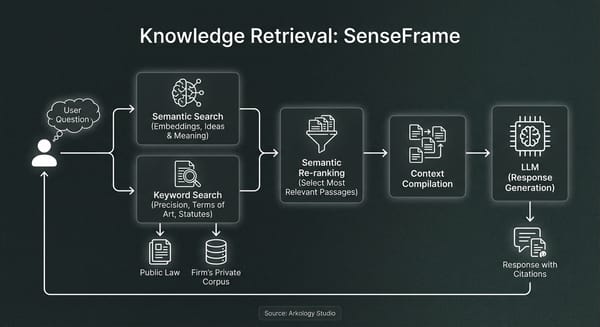
SenseFrame uses a hybrid RAG pipeline that blends:
- Neural semantic search (to understand meaning)
- Classic keyword search (to ensure legal precision)
- Semantic re-ranking (to surface the most relevant context)
The system runs this retrieval across two major sources:
- Public law — legislation, case law, and other statutory materials
- The attorney’s private corpus — scanned PDFs, images, notes, internal memos, etc.
This combination gives attorneys high-quality answers grounded in the material that matters for their casework. Private documents are uploaded and processed through OCR (if the document is a scan), encrypted, chunked, embedded, and indexed so the assistant can surface relevant insights across a large corpus.
A Shoutout to Laws.Africa
For public law, we integrate directly with Laws.Africa, a nonprofit working to digitise legislation and judgments across the continent. Their mission – building a machine-friendly, openly licensed legislation commons for the continent — is driven by the belief that people should have free, reliable access to the laws that govern them. Their mission aligns with our ongoing experimental project, P2P Data Commons, which attempts to support sensemaking across existing data silos by weaving together community knowledge bases over trusted, peer-to-peer networks.
Working with the Laws.Africa API allowed us to provide users with a accurate, up-to-date public law corpus for South Africa without having to develop in-house ingestion pipelines for complex legal artefacts – many of which are still to be fully 'digitised'.
The Privacy Challenge (POPIA & attorney–client confidentiality)
We’ll share a full deep-dive in a later post, but here’s the short version:
South Africa’s POPIA Act and the sensitive nature of legal work mean that confidentiality had to be built in as the foundation. So we architected SenseFrame around private, isolated Azure resources inside South Africa using private networking, encryption, locked-down storage, and model providers who never use user data for training. All private documents are stored, processed & encrypted on secure infrastructure, inside South Africa. This gave us assurances that sensitive attorney/client data would remain secure while respecting SA’s data privacy laws.
How AI Helped Us Build an AI Assistant
We also leaned heavily on AI in our own workflow. Just two years ago, software development at Arkology Studio necessitated proficiency across multiple programming languages and frameworks, time-consuming code-reviews, and, admittedly, many late-night bug hunting across multi-repository codebases. Like many engineering teams, AI has become a quiet but powerful part of how we build software.

For SenseFrame, our AI-assisted development workflow frequently involved:
- Claude Code for complex, infrastructure development & multi-file features
- Cursor IDE for rapid front-end development & standard features
- MCP servers for developer documentation retrieval and communication with external tools such as Figma (UI/UX Design)
- Specialised “sub-agents” for design-to-code, schema alignment, and Azure infra provisioning + Claude ‘Skills’ for enhancing agent capability through examples and resource bundles.
The AI(s) didn’t replace our team. Instead, it allowed us to focus on system design and tackle ambitious coding tasks with greater confidence over shorter timelines. By freeing up mental energy from repetitive low-level tasks, we could focus on decisions that mattered: architecture, security, compliance, and ultimately, product experience.
Similarly, in SenseFrame, AI handles the grunt work so attorneys can spend more time on creative problem solving, client communication and case articulation.
What’s Next
Over the next few posts, we’ll share deeper dives into:
- How the SenseFrame public/private knowledge-retrieval pipeline works end-to-end (Read Part 2 here)
- How we engineered POPIA-aligned, privacy-centric AI infrastructure in South Africa
- How our studio integrates AI workflows into our design & engineering process
By Arkology Studio — purpose-led systems design & software engineering studio